
Food Thinkers- The Urban Food Agenda: Aligning Research and Policy
I recently attended the The Urban Food Agenda: Aligning Research and Policy webinar on 20th March 2024 hosted by the Centre for Food Policy (City, University of London), as part of their Food Thinkers seminar series. This 90-minute webinar featured a presentation by Prof. Roberta Sonnino, Professor of Sustainable Food Systems in the Centre for Environment and Sustainability, University of Surrey.
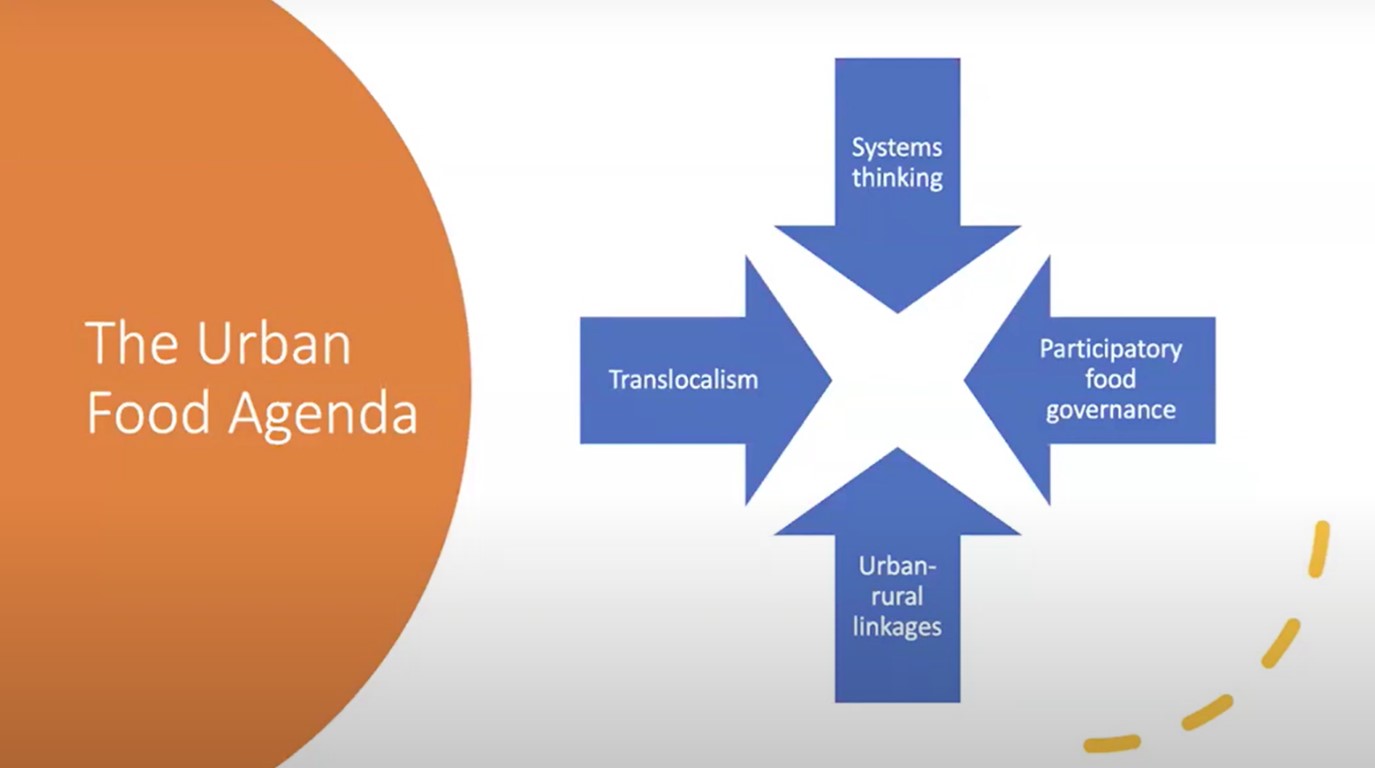
Prof. Sonnino set the context for the webinar by identifying that cities are strategic sites through which sustainable development can be pursued and how cities may be the ideal scale for food policies and food innovations to be enacted. She, thus, advocated for policymakers to adopt an Urban Food Agenda, the four pillars of which she considers as systems thinking, participatory food governance, urban-rural linkages, and translocalism.
Systems thinking promotes structuring urban food policies around the interconnections between food, society, community and various business sectors, whilst participatory food governance refers to the wider set of actors that policymakers should engage with to inform decision-making in a pro-active, rather than reactive way. Rural-urban linkages involves using food to strengthen the socio-economic and environmental relationships between urban and rural areas in a new and less exploitative way, whilst understanding the rural as part of the city. Moreover, translocalism refers to the creation of opportunities (such as the FAO Food for Cities initiative and UK Sustainable Food Places Network) for policymakers to share ideas and collective visions for food systems transformations.
From a methodological perspective, Prof. Sonnino discussed how discourse analysis has been a key research method for analysing urban food policies, leading to a large quantity of case studies. She described how case studies have performative power and how some frequently researched cities have become emblematic of food innovation. Prof. Sonnino was self-reflective on her previous research, highlighting how a focus on best practice and fetishization of the urban potentially creates an uneven geography of successes and failures in food policy. Thus, she calls for an end to performance-based governance whereby statistics and metrics mask the complexity and heterogeneity of formal and informal food, societal, political, and financial systems in different urban environments. She also argued that the quantification of urban food systems detracts from addressing their key issues and challenges, such as societal inequalities, environmental degradation, and institutional lethargy.
Prof. Sonnino argued that interventions in knowledge, investment, regulation and legislation are needed from national governments to support regional policymakers to strengthen urban food systems. She argued that cities have great power to transform food systems if given support. She called for researchers and policymakers to move away from notions of resilience and instead prioritise everyday food practices and citizens’ needs. She also contended that “to be politically meaningful, the urban food agenda needs to engage with issues of power”, calling for research to consider who is powerful/powerless in this realm.
Outlining a new research and policy urban food agenda, Prof. Sonnino called for the deconstruction of the notions of participation and inclusivity, consideration of the multi-scalar, historic, geographic, and relational contexts in which food systems and policies are operating, addressing the urban as both a process and outcome, and developing participatory methods that value citizens’ embodied experiences. She proposed a fundamentally place-based approach to transforming urban food systems.
Prof. Soninno ended the webinar by highlighting how theoretical approaches to urban food systems may be put into practice, proposing the CLIC framework (Co-benefits, Linkages, Inclusion and Connectivities), which has recently received 12 million euroes of funding from the European Commission. As such, she will be testing out the CLIC framework and place-based approach, informed by the theoretical work discussed earlier in the presentation, across eight city-regions. Example recommendations under the CLIC framework include promoting urban agriculture that benefits social cohesion, job opportunities and access to nature (Co-benefits), encouraging food distribution practices that support local biodiversity (Linkages), taking research to diverse communities (Inclusion), and acknowledging the benefits of food systems alongside wider socio-economic and environmental policies (Connectivities).
A recording of the webinar is available here: https://youtu.be/iK40Jo5oPv8?si=i8mfA0ib759tYjSN
Read More


Comments
To post your comment, you need to log-in first. Click here to Log-in.
No Comments yet. Be the first to add a comment. :)